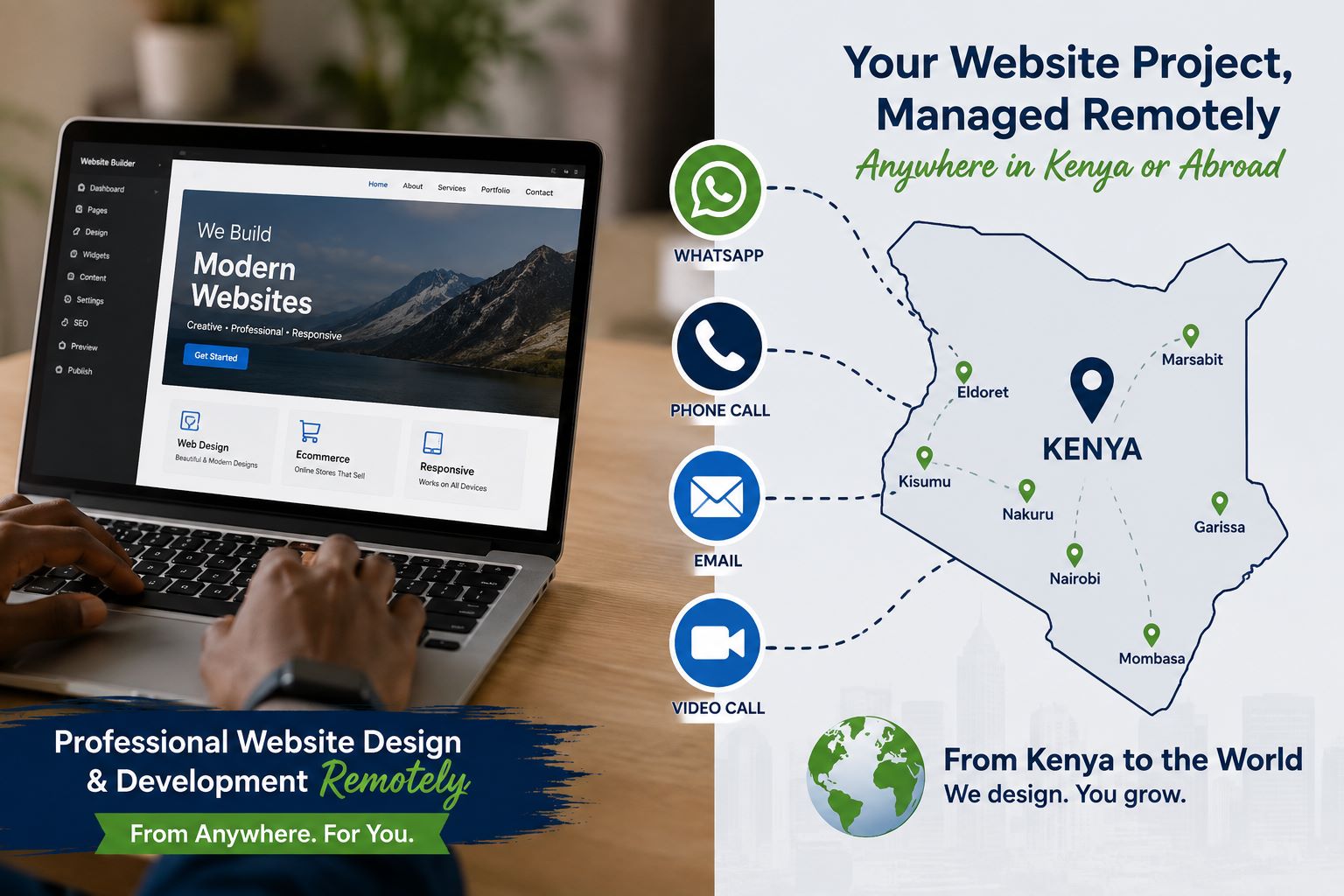
For years, the assumption in Kenya has been simple: if you want a proper website, you travel to Nairobi. You find a web design office, sit across a desk, hand over a flash disk with your logo, and hope the developer understands what your business needs. For a farmer in Nyeri, a hotel owner in Kisumu, or a consultant based in London with a business back home in Machakos, that assumption alone has quietly discouraged a lot of good businesses from ever getting a website at all.
That assumption no longer holds. Professional website design and development in Kenya has moved almost entirely online — the same way businesses now order stock, sign contracts, and hold meetings without ever leaving their desks. A website project can be scoped, designed, built, reviewed, launched, and maintained without a single physical meeting.
This article explains how that works in practice, why location is no longer a real barrier to getting a professional site, and how Leem Technology Solutions — a web design company in Kenya that has spent years building and maintaining websites for clients across the country and beyond — delivers full website and e-commerce projects remotely, often without ever meeting the client in person.
Do You Really Need to Travel to Nairobi to Get a Website?
No — not for the vast majority of website and e-commerce projects. This is worth stating plainly, because a lot of business owners still hold back from starting a website project simply because they assume it requires an in-person visit.
A website is, at its core, digital work: design files, content, code, and configuration. None of that requires the developer and the client to be in the same room. What it requires is clear communication — and clear communication today happens over WhatsApp, phone calls, email, and video calls just as effectively as it happens across a table.

There are a small number of cases where an in-person meeting genuinely helps — for example, a large institutional client running a multi-department internal workshop to map out complex requirements, or a business that specifically wants a physical product photography session done on-site. Even in those cases, the meeting is a convenience, not a requirement. The design, development, testing, and launch of the website itself still happen remotely.
How Remote Website Design and Development Works
Understanding the remote process removes most of the uncertainty around it. Here is how a typical project runs from first contact to a live website, without any office visit:
- Initial contact: The client reaches out through phone, WhatsApp, email, or the company’s website — whichever is most convenient for them.
- Discovery conversation: The client explains their business, organization, or project goals. This can happen over a phone call, a WhatsApp voice note exchange, or a video call if preferred.
- Scoping and recommendation: Based on that conversation, the web development team proposes the right solution — a business website, an e-commerce store, a booking platform, or a custom system — along with a timeline and cost.
- Sharing materials: The client sends over content, branding guidelines, logos, product images, and any reference sites they like, all electronically — no flash disks or physical handovers needed.
- Design and development: The team designs and builds the site, working from the shared materials and the agreed brief.
- Remote review: The client is given a live preview link to review progress on their own phone or laptop, at their own pace, and provide feedback in writing or on a call.
- Revisions: Any changes requested are made and shared back the same way, often within the same day.
- Launch: Once approved, the website is published to a live domain, fully accessible to the public.
- Ongoing support: After launch, updates, content changes, troubleshooting, backups, and security monitoring continue remotely for as long as the client needs support.
Video meetings are used where they genuinely add value — for example, a live screen-share walkthrough of a finished design — but they are one tool among several, not a mandatory step.
Why Location Is No Longer a Barrier to Professional Web Design
A decade ago, remote collaboration on a technical project like website development felt unfamiliar to many business owners. Today, it is the default way most professional services are delivered, from accounting to legal consultation to graphic design.
Several things have made this shift possible for website design and development specifically:
- Reliable mobile data and broadband coverage across most Kenyan towns and counties.
- Widespread use of WhatsApp for business communication, file sharing, and quick approvals.
- Cloud-based design previews that let a client view a working website from any device, anywhere.
- Secure online payment and invoicing, removing the need to meet in person to handle money.
- Cloud hosting and domain management, which means a website can be launched and managed entirely online.
The practical result is that a business in Eldoret, Kakamega, or Nakuru now has access to the same quality of web design services in Kenya as a business headquartered in Nairobi’s central business district. Distance no longer determines the quality of website a business can get — only the choice of developer does.
Leem Technology Solutions: Serving Clients Remotely
Leem Technology Solutions has built its way of working around this reality. As a professional web design company in Kenya, the company works with businesses, institutions, professionals, and individuals across the country and internationally — and remote collaboration is the norm, not the exception.
In practice, approximately 90% of Leem Technology Solutions’ clients are served entirely remotely, and in a large number of these cases, the team has never physically met the client. Projects have been scoped, designed, built, reviewed, launched, and supported entirely through phone calls, WhatsApp, email, and online file sharing — from first inquiry to a fully live website.
This isn’t a limitation of the service. It’s evidence that professional website design and development, when handled by an experienced team with a clear process, does not depend on physical proximity. Clients get the same level of attention, design quality, and technical care whether they are five minutes from the office or in a different country altogether.
Website Design and E-Commerce Development Without Office Visits
Both standard business websites and full e-commerce platforms can be ordered and managed remotely, from start to finish.
For a standard business website — for a professional practice, an NGO, a school, a hotel, or a service provider — the client shares their business information, service details, images, and branding preferences, and the site is designed and built around that content. Reviews happen through a shared preview link, and the finished site is launched online once approved.
For e-commerce website development in Kenya, the process is more involved but no less remote-friendly. It typically includes setting up the product catalogue, categories, and pricing; configuring payment options such as M-Pesa and card payments; setting up delivery or shipping rules; and testing the checkout process end-to-end. All of this can be done using product spreadsheets, images, and information the client sends electronically, with the client testing the live store themselves before it goes public.
Whether the goal is a professional website design and development project for a service business or a full e-commerce website design in Kenya for a retail brand, the remote workflow covers the entire project — not just the initial design phase.
Can Website Maintenance and Technical Support Also Be Done Remotely?
Yes. Website maintenance is, if anything, even more naturally suited to remote delivery than the initial build, since most maintenance work happens directly on the server and codebase rather than in person.
Remote website maintenance services typically cover:
- Content updates — adding new pages, products, blog posts, images, or pricing changes.
- Software and plugin updates to keep the website secure and running smoothly.
- Security monitoring and malware checks.
- Regular backups, so the website can be restored quickly if something goes wrong.
- Troubleshooting broken pages, forms, or payment integrations.
- Performance checks to keep loading speed and uptime consistent.
- General technical support and guidance for the client’s own team.
A client can report an issue over WhatsApp or email, the team can access the website’s hosting and admin panel remotely, resolve the issue, and confirm the fix with the client — all without a site visit. This is how most website maintenance is handled industry-wide, not just by Leem Technology Solutions.
Why Choose Leem Technology Solutions?
There are many web design companies in Kenya. What sets an experienced, professional team apart is a track record of delivering real projects, communicating clearly, and supporting clients long after launch — not just building a site and disappearing.
Leem Technology Solutions brings:
- Hands-on experience designing and developing websites and e-commerce platforms across a wide range of industries, from hospitality and tourism to agriculture, security systems, healthcare, and professional services.
- A proven remote workflow, refined through consistently working with clients who are not physically present, across Kenya and abroad.
- Practical e-commerce expertise, including product setup, payment integration, and store management.
- Ongoing website maintenance and technical support, so a website keeps working well long after it goes live.
- Clear, responsive communication through the channels clients already use daily — phone, WhatsApp, and email.
None of this depends on the client being in Nairobi or anywhere near it. It depends on a clear process and consistent communication — which is exactly what a remote-first way of working is built around.
Who Can Benefit From Remote Website Services?
Remote website design and development works well for almost any type of business or organization, including:
- Small businesses and startups looking for an affordable, professional first website.
- E-commerce businesses that want to sell products online with M-Pesa and card payment options.
- Tour and travel companies showcasing packages, destinations, and booking forms.
- Hotels and hospitality businesses needing bookings, galleries, and location information online.
- NGOs and non-profits sharing their work, programs, and donor information.
- Schools and educational institutions publishing admissions information and updates.
- Professional service providers such as consultants, lawyers, and healthcare practitioners.
- Real estate companies listing properties with images and details.
- Contractors and manufacturers showcasing services, projects, and capabilities.
- Retail businesses moving part or all of their sales online.
- Consultants and personal brands building a professional online presence.
- Kenyan businesses and entrepreneurs based abroad who still need a strong online presence back home.
You Can Get Your Website From Anywhere
Whether based in Nairobi, Mombasa, Kisumu, Nakuru, Eldoret, Kiambu, Thika, Nyeri, Murang’a, Machakos, Kakamega, or any other town or county in Kenya — or living outside Kenya altogether — a business owner can work with an experienced Kenyan web design and development team without ever visiting an office.
The location of the client has no bearing on the quality of the website, the professionalism of the process, or the level of ongoing support available. What matters is choosing a team with a clear process, solid technical skills, and a track record of delivering — and being reachable, remotely, whenever needed.
Conclusion
The idea that a professional website requires a trip to Nairobi and an in-person meeting is outdated. Modern communication tools — WhatsApp, phone calls, email, video calls, and secure file sharing — make it entirely possible to scope, design, build, launch, and maintain a website or e-commerce platform without ever stepping into an office.
Leem Technology Solutions has built its way of working around exactly this reality, supporting the large majority of its clients remotely — many of whom the team has never met in person — while still delivering professional, fully functional websites and e-commerce platforms with reliable ongoing support.
If you have a business, organization, or idea that needs a professional website or online store, distance should not be the reason it waits any longer. Reach out to Leem Technology Solutions by phone, WhatsApp, email, or through the website to discuss your project — wherever you happen to be.
Get in Touch with us
- Call /WhatsApp us : 0714 145 075 / 0725 111 900
- Write to us : info@leemtechsolutions.co.ke
- Visit us: Kimathi House, 5th Floor, Kimathi Street Nairobi
Frequently Asked Questions
Do I need to travel to Nairobi to get a website designed?
No. A professional website can be fully designed, built, reviewed, and launched remotely through phone calls, WhatsApp, email, and online file sharing, without ever visiting an office in Nairobi.
Can I hire a website designer remotely in Kenya?
Yes. Most website design projects in Kenya today are handled remotely, from the initial consultation through to design, development, review, and launch, regardless of where the client is based.
Can Leem Technology Solutions design a website without meeting the client physically?
Yes. Approximately 90% of Leem Technology Solutions’ clients are served remotely, and many have never met the team in person. Projects are scoped, built, and supported entirely through digital communication.
Can an e-commerce website be developed remotely?
Yes. Product catalogues, images, pricing, payment integration such as M-Pesa, and checkout testing can all be handled remotely, with the client reviewing and approving the live store before it goes public.
Can website maintenance be done remotely?
Yes. Content updates, security monitoring, backups, troubleshooting, and technical support are typically carried out directly on the website’s hosting and admin systems, which does not require a physical visit.
Can I work with a Kenyan web developer if I live outside Kenya?
Yes. Kenyans and businesses based abroad regularly work with Kenyan web design and development teams remotely, communicating through email, WhatsApp, and video calls across time zones.
How do I start a website project remotely?
Start by reaching out through phone, WhatsApp, email, or the company’s website, explain your business and goals, and share your content and branding materials electronically. From there, the design and development process begins.